Sage
Since the Roman era, sage was considered the plant of longevity, and that is why the genus name Salvia comes from the Latin verb salvo, meaning “to save/heal.” The species name officinalis derives from the word officina, which was used for the storage of herbs and medicines in monasteries. Today, it is also known as salvia officinalis or elelifaskos (Greek common name), while its common English name is sage, garden sage, or common sage.
The genus Salvia includes about 900 species, more than 20 of which exist in Greece. S. officinalis is the most widespread species and grows in the western part of the Balkan Peninsula, in Greece, Albania, the former Yugoslavia, and Northern Italy. In Greece, this species thrives in northwestern Epirus at altitudes of 600–950 m. It grows wild in shrublands and in mixed deciduous zones in the mountains Vorras, Pinovo, Vermio, Vourinos, Smolikas, Mitsikeli, and Tymfi, with its southernmost distribution limit in the northern regions of Arta. It is a non-threatened species and does not require special protection.
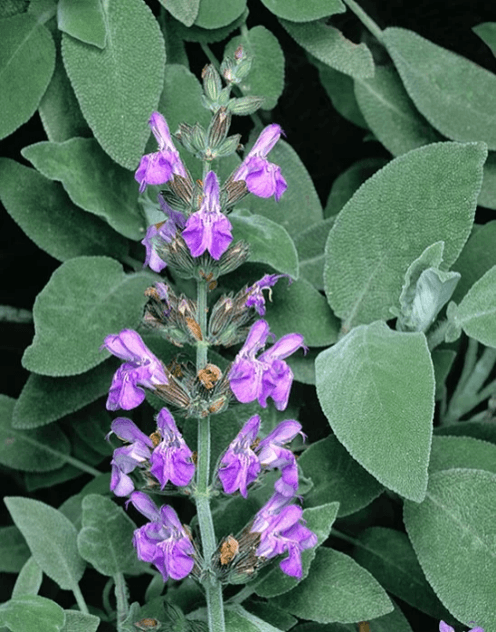
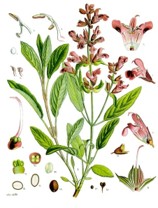
Sage is a small-sized, perennial, evergreen shrub, reaching a maximum height of 70 cm. The stem is much-branched, square-shaped, and hairy. The leaves are elongated, pointed, green, with whitish fuzz on the underside. The flowers are violet in color, sometimes leaning more toward red and other times toward blue.
It thrives in barren, rocky soils, with neutral to slightly acidic pH. It is drought-resistant, prefers sunshine, and does not have high water requirements. Flowering begins in April and ends in early May, depending on the geographical coordinates of the cultivation area. For essential oil production, the aerial part of the plant is harvested at full bloom, while for dry herb production, harvesting takes place just before flowering.
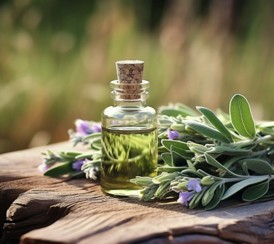
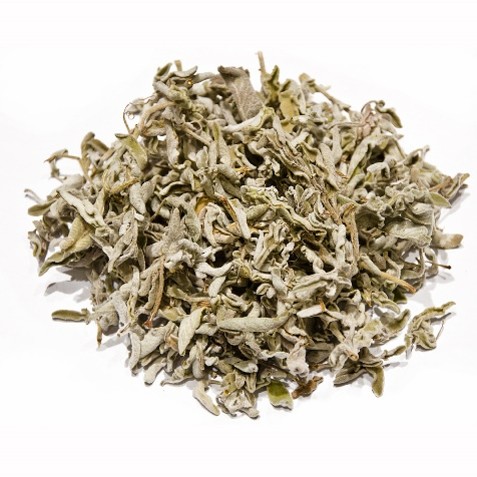
S. officinalis has medicinal and antioxidant properties and is available commercially in the form of essential oil or dried herb. The essential oil is widely known for its medicinal qualities, including antimicrobial, anti-inflammatory, and even anticancer activity, as well as benefits against cholesterol and anxiety. It is also used in perfumery.
Sage is used in cooking as a seasoning because of its strong and pleasant aroma, as well as in the baking industry. It is also worth noting that it is used as a preservative in food and beverages. It is consumed as an herbal tea since it acts as an emmenagogue, antiseptic, hypoglycemic, cardiotonic, and diuretic, while it significantly aids digestion and the treatment of mouth and throat inflammations. It is also used as an insect repellent and helps relieve insect bites. Due to its high content of volatile compounds and antimicrobial action, it is also used in toothpastes. In addition, it is considered a melliferous plant and produces honey of excellent quality.
Consumption is not allowed during pregnancy, as it may cause uterine contractions and consequently miscarriage, while during breastfeeding it alters the quality and taste of breast milk and may even lead to its suppression. However, research has shown that the plant’s essential oil helps with Alzheimer’s disease and hyperlipidemia. Finally, sage is widely used in landscape architecture and is often preferred in rock gardens or flower beds together with other aromatic plants.