
Yellow Autumn Daffodil
Sternbergia lutea
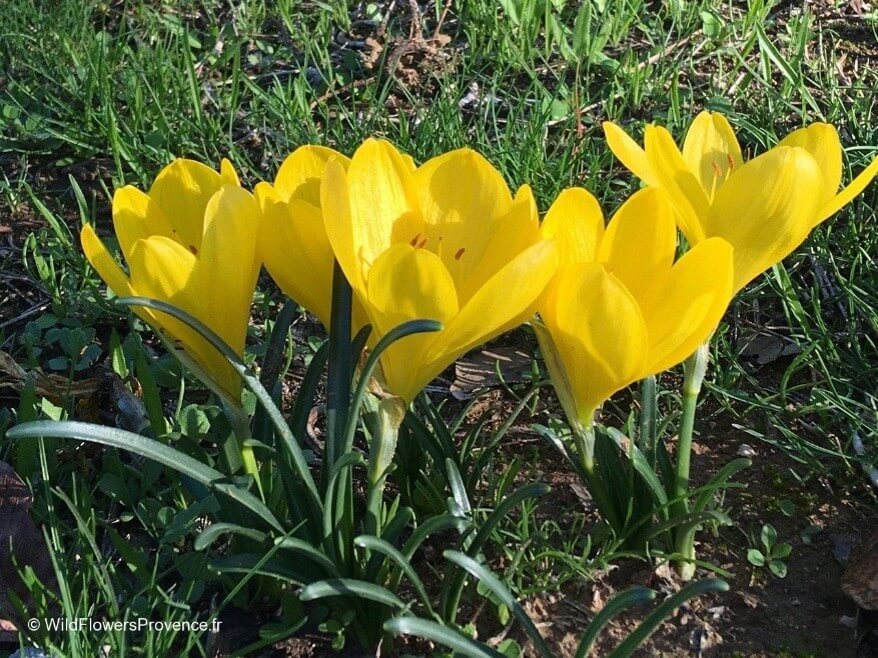
The plant Sternbergia lutea (L.) Ker Gawl. ex Spreng. belongs to the family Amaryllidaceae and is a perennial geophyte with autumn flowering. The name of the genus honors the botanist Kaspar Moritz von Sternberg, while the word lutea means “yellow” in Latin. The species occurs in the Mediterranean and parts of the Middle East, where natural populations prefer rocky, well-drained sites with alkaline or calcareous soil.
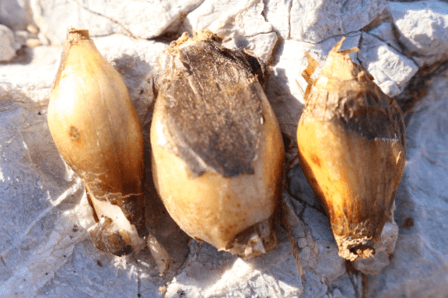
The bulb of the plant is subspherical, with a diameter of 3–5 cm, while the leaves are lanceolate, elongated, appearing in autumn and persisting until spring before withering in summer. The yellow flowers usually appear in autumn, with tepals* about 3–3.5 cm long, bearing 6 stamens and one stigma. Several subspecies exist, such as subsp. sicula, which is found in Greece, particularly in Crete.
The phenology of Sternbergia lutea is characterized by the simultaneous appearance of leaves and flowers in autumn (synanthous), followed by a period of dormancy during the hot, dry summer (25–35 °C). Studies have shown significant seasonal changes in biochemical compounds such as soluble sugars and proline, which contribute to the plant’s resistance to Mediterranean drought conditions.
Sternbergia lutea thrives in areas where winter temperatures rarely fall below –18 °C, while it requires summer drought and full sun exposure. Planting takes place at the end of summer or the beginning of autumn, at a depth of 2–3 times the size of the bulb, while reproduction can occur through seeds or bulb division. Propagation by seed requires several years before the first flowering, whereas bulb division provides a faster method.
The use of Sternbergia lutea in medicine is still at an early stage, despite promising results from studies. The main limitations are the low concentration of active alkaloids (e.g., galantamine ~0.01–0.016%), toxicity at high doses, and the need for further in vivo and clinical studies.
Overall, Sternbergia lutea is an important Mediterranean geophyte, well adapted to the climatic conditions of the region, though its medicinal applications remain limited for now. In Greece, its presence in both natural and cultivated habitats contributes to biodiversity conservation and shows potential as an ornamental plant.
*Tepals are the segments of the perianth of a flower when there is no clear distinction between petals and sepals; they form the outer parts that protect the reproductive organs of the plant and attract pollinators.